작살나무의 진화 방법에 대해
Callicarpa japonica (Japanese beautyberry) is a species within the Callicarpagenus, which originated in East and Southeast Asia during the Eocene epoch (approximately 35.5 million years ago). It is a deciduous shrub in the Lamiaceae (mint) family, and part of the Subfamily Callicarpoideae.
Evolutionary History and Biogeography
- Origin: The Callicarpa genus likely originated in East and Southeast Asia about 35.53 Ma (Million years ago), with major diversification occurring during the Miocene to Pleistocene.
- Diversification: The genus shows a pattern of early bursts of speciation that have gradually declined over time, with low, constant extinction rates.
- Dispersal: The violet-fruited lineage—which includes C. japonica—is the most common, broadly distributed, and associated with the highest diversification rates within the genus.
Evolutionary Characteristics of Japanese Beautyberry
- Fruit Evolution: The striking purple fruits, which often last after leaf drop, evolved as a mechanism for bird-driven seed dispersal.
- Fruit Distribution: The berries of C. japonica are typically smaller than the American beautyberry (C. americana) and are produced on current-season wood, forming in dense clusters around the stem.
- Habitat Adaptation: It is adapted to shady woodland edges but thrives in full sun, making it a highly adaptable understory plant.
- Native Range & Cultivation: C. japonica is native to Japan, China, Korea, the Ryukyu Islands, and Taiwan. It was introduced to Western cultivation around 1845.
- Variations: White-fruited forms (Callicarpa japonica f. leucocarpa) exist, representing a lack of purple pigmentation.
Phylogenetic Relationships
- Callicarpa is closely linked with other Asian species. Research indicates that Callicarpa species on the Ogasawara Islands (such as C. glabra and C. parvifolia) are endemic, showing distinct island evolution.
- While C. americana is the Native American counterpart, C. japonica is highly favored in Asian landscapes and ornamental gardens for its prolific, colorful, and long-lasting fruiting in autumn.
참고
Which fruit color is most common?
The most common fruit colour of Callicarpa species was violet (53.7% of all Callicarpa species; 58.7% on consensus tree). The second most common was red (25.3% overall, 15.2% on the tree), then white (13.7% overall, 17.4% on the tree), and lastly black (7.3% overall, 8.7% on the tree).
Combining the divergence time of species and the SIMMAP results, we discovered that the order of occurrence of different fruit colours in Callicarpawas violet, red, white, and then black.
Most dispersal events were associated with violet-coloured fruit lineages.
There was no major change in branch structure, different fruit colour branches still clustered together, and violet fruits still had the highest number of reconstructions.
The fruit colour with the highest dispersal frequency was violet (3.47) followed by white (2.24). Red fruits (2.19) were less frequently associated with dispersal events, and black fruits (2.09) were the least associated with dispersal events
Dispersal distances of the four fruit colours differed significantly. The fruit colour with the greatest dispersal distance was violet, followed by that for white, red, and black
Correlation of fruit colours with geographical variables, and diversification rates
Violet fruits were positively correlated with the combination of mean elevational range and mean latitudinal range. Red fruits were negatively correlated with mean latitudinal range. Black fruits were negatively correlated with the mean latitudinal range and white fruits were positively correlated with the mean elevational range.
Violet fruits had the highest diversification rate and were positively correlated with the diversification rate of Callicarpa. This finding indicates why violet fruit, which is distributed broadly in the eight regions, is the most common fruit in Callicarpa.
Fruit colour and geographic distribution
Violet fruit is associated with higher elevations and latitudes and is distributed throughout the eight distribution regions examined.
Red fruits are largely found at lower latitudes and concentrated mainly in tropical regions, but also occur in moderate numbers at higher latitudes. White fruit is positively correlated with higher elevations and is more widespread. Black fruit is correlated with lower latitudes and concentrated in the tropics

These results help us understand the variety of fruit colours on the evolutionary branches of Callicarpa.
How did bioenvironmental factors promote such a distribution pattern? It has been documented that frugivory occurs more frequently at higher latitudes and lower elevations. Moreover, avian perceivers prefer darker fruits, including red and violet fruits.
Another bioenvironmental factor that may explain this pattern is anthocyanin content. Anthocyanins, which absorb high levels of radiation, are synthesised in fruits to prevent frostbite in colder temperate areas. 안토시아닌(Anthocyanin)은 – 꽃, 과일, 채소의 보라색, 검은색, 붉은색을 띠는 강력한 수용성 항산화 색소 – 블루베리, 검은콩, 포도 등 검보라색 식물에 풍부한 천연 수용성 색소이자 강력한 항산화 성분입니다. 세포 산화를 막아 노화 방지, 시력 보호, 혈관 건강 개선, 염증 완화, 암 예방 등에 도움을 주는 ‘파이토케미컬’로, 식물이 스스로를 보호하기 위해 만들어내는 물질입니다. The correlation between deep-coloured fruits (e.g., violet, red, black) and lower latitudes may also be explained by Gloger’s rule, which suggests changes in selection pressure (e.g., UV irradiance) favour darker animals at latitudes closer to the equator
Taken together, these studies help interpret the spatial distribution of violet fruit investigated in our study. Previous studies on the global distribution of coloured fruit species has shown that red fruit is more common at higher latitudes. However, for Callicarpa, red fruit is mainly distributed in the low latitudes of the tropics, with 23 species in Southeast Asia.
Why has violet fruit adapted to habitats at higher elevations? Anthocyanins not only provide visual cues for animals to induce pollination or seed dispersal, but also act as a light-energy absorption and reflection system that effectively protects plants against the damage caused by UV radiations.
Plants that grow in habitats at relatively high elevations and low latitudes are generally thought to be exposed to high levels of UV radiation. For instance, studies have indicated that delphinidin, which is involved in the synthesis of purple anthocyanins, was first produced in gymnosperms at high elevation habitats during the Carboniferous period to protect against intense UV radiation damage. In addition, studies on skin colour in humans and lizards have shown that populations at higher elevations consist of darker-skinned individuals.
Intriguingly, white fruit were associated with higher elevation. During our field observations, white fruit species of Callicarpa, such as C. kochiana, C. longifolia, and C. macrophylla, were usually found in shady places of the understory, and appeared more conspicuous in dark environments. These fruits had higher water content than fruits of other colours and were probably favoured by the birds.
Fruit colour and biogeographical dispersal
Violet fruit were most significantly correlated with dispersal distance and dispersal frequency. Dispersal has been shown to underlie variance in speciation spanning biogeographical areas. Essentially, animal-mediated dispersal of seeds influences how ecosystems respond to global change, and nearly half of all plant species are dependent on animal activity to migrate seeds in order to adapt to climate change. Nevertheless, no specific predators of Callicarpafruit have been reported to date. Our field observations lead us to speculate that birds may be an important medium for spreading the fruits of Callicarpa. There are three birds from North America that most likely prey on the violet fruit of Callicarpa. Additionally, Zosterops japonicus and Spizixos semitorques have been recorded feeding on violet fruit of Callicarpa in Taiwan and Beijing (China), respectively.
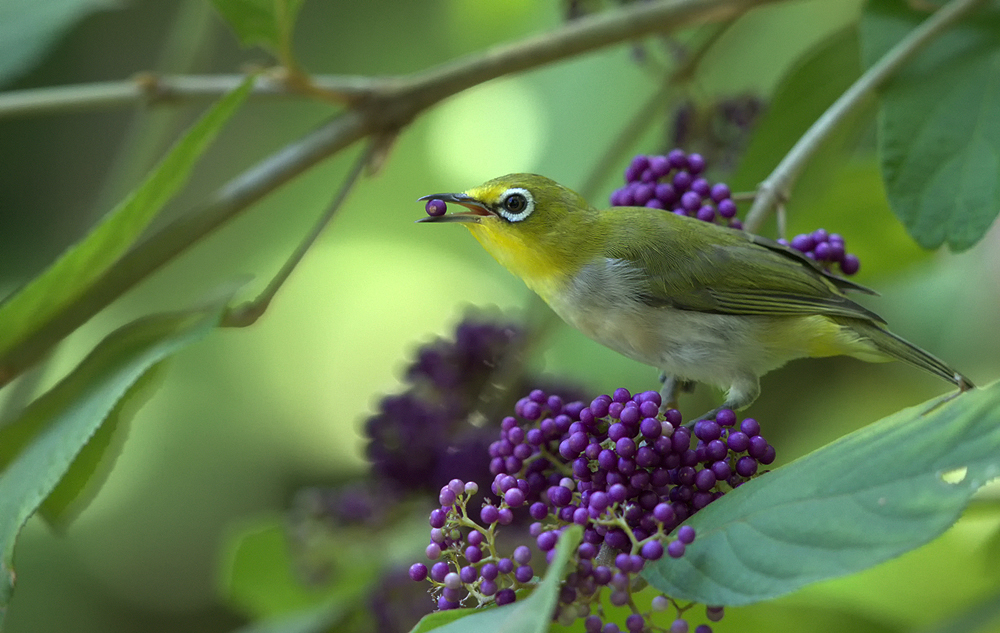
Z. japonicus are found in many areas between Japan and the Philippines. herefore, we speculate that the involvement of birds in spreading fruits may be an important factor that explains why violet fruit had the most striking dispersal frequency and distance, further explaining why they occur on the largest number of Callicarpa species. However, white fruit may also attract birds to achieve significant dispersal frequency and distance.
Long-distance dispersal and overwater dispersal events may be associated with red fruit. Although we found no evidence that red fruit is significantly involved in dispersal events in Callicarpa, the dispersal distance was the third highest for red fruit. The lack of a correlation between red fruit and dispersal events may be ascribed to insufficient sampling, a lower proportion of species (25.3%), and restricted habitats. Black fruit was also not strongly correlated with dispersal events, which may be a result of the small proportion of species in our study (7.3%).
It has been reported that the blue fruits of Viburnum Linn. contain high lipid content, enabling migratory birds to absorb more nutrients to meet their daily energy requirements, while the red and black fruits are quite juicy and contain little sugar, offering a low-quality reward.
Fruit colours and species diversification
Purple (violet) fruits accelerated diversification rate in contrast to other fruit colours (e.g. red fruits) in tribe Gaultherieae (Ericaceae) and Viburnum(Adoxaceae). In addition, previous studies on palms have reported that diversification rates are higher for plant groups with violet-coloured fruit than for those with red or white fruit. Thus, particular fruit colours might influence the diversification of different angiosperm lineages in a similar way.
Why do violet fruits promote species diversity in Callicarpa? Previous studies have suggested that low-latitude habitats accelerate diversification, especially higher elevation tropical environments. Although the violet fruits of Callicarpaare positively correlated with latitude and elevation, a large number of species with violet fruits, including duplicate species, are distributed at low tropical latitudes. Thus, we speculate that violet fruits are more adapted to variable environments, as previously documented for violet fruit in Delphinidin, which can resist intense UV radiation severe cold, and survive in multiple temperature zones and altitude gradients. Such morphological characteristics may be one explanation for the strong anti-adversity of the Callicarpa (e.g. two carpels; berries; pericarp has metallic luster; hair on the leaves; erect shrub, woody climber, or trees).
In addition, our finding that violet fruits were most frequently involved in dispersal events and dispersed the longest distances relative to other fruit colours suggests that violet fruits may have a stronger dispersal ability to promote the diversification rate of Callicarpa. Simultaneously, our findings may also be attributed to violet fruits being favoured by birds (Fig. 6), which may facilitate seed dispersal, increase the chances of establishing isolated populations, and enhance the rate of species evolution. In contrast, red-fruited and black-fruited species may have remained in the tropics due to limitations in habitat and survivability. Furthermore, more large predators have been reported to live at lower latitudes in the tropics than at higher latitudes. Thus, the distribution of red and black fruits of Callicarpa may be affected by the feeding and shorter life routes of these large predators.
Violet fruits then showed accelerated diversification and high species richness in various habitats. In summary, these patterns are consistent with not only the distribution of Callicarpa but also the biogeographical reconstruction, fruit-colour evolution, and relationships between fruit colour and geographic factors. Therefore, our findings indicate that at the genus level violet fruits may play a crucial role in promoting species diversity in angiosperms.
However, red fruits are more frequently involved in interregional dispersal events, and violet fruits accelerate the diversification rate to drive variation in fruit colour over macroevolutionary time scales in the tribe Gaultherieae (Ericaceae). Alternatively, the difference between these two diversification patterns may depend on the specific frugivorous dispersers, dispersal patterns, and spatial distribution and dispersal ability of different fruit colours.
Conclusion
violet fruit is correlated with higher latitudes and elevations, red with lower latitudes, white with higher elevations, and black with lower latitudes. Furthermore, all fruit colours were involved in dispersal events; however, the involvement of violet fruit was markedly higher. Most importantly, violet fruit promoted diversification in Callicarpaand drove the evolution and diversity of different fruit colours between regions.