개암나무(hazel tree)

Hazel trees are deciduous, so they lose their leaves in winter. Hazel trees are wind pollinated but some bees will visit the catkins for pollen.
Flowers
Hazel is monoecious, meaning that both male and female flowers are found on the same tree, although hazel flowers must be pollinated by pollen from other hazel trees. The yellow male catkins appear before the leaves and hang in clusters from mid-February. And male flowers release pollen before falling off. Female flowers are tiny and red, and appear as wispy red petals protruding from a small bud, typically on the branch just above the catkin.
Fruits
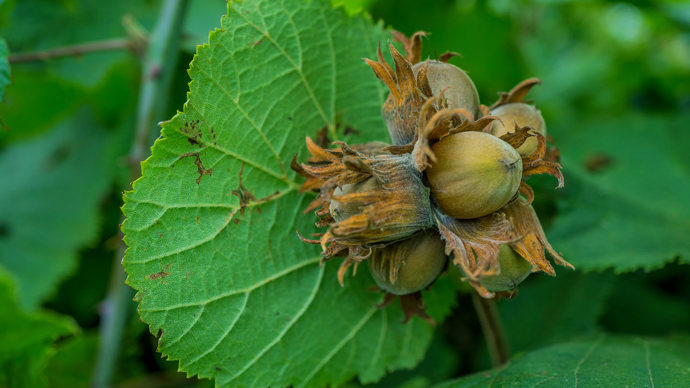
Once pollinated by wind, the female flowers develop into oval fruits which hang in groups of one to four. They mature into a nut with a woody shell surrounded by a cup of leafy bracts (modified leaves).
Value to wildlife

Hazel trees are a valuable resource for wildlife, providing food for insects, birds, squirrels and dormice, as well as a habitat for butterflies. Hazel trees are also used by birds to shelter in. In woodland, hazel trees are coppiced to help create a better habitat for wildlife, mimicking the actions of beavers. The result is a multi-stemmed shrub, which provides a place for dormice to nest and also lets more light into the woodland. This allows more flowers to grow on the ground, which is good for pollinators.
- Hazel a food plant for the caterpillars of moths including the nut tree tussock and large emerald moth
- In woodland, coppiced hazel lets light in to the woodland floor, providing a habitat for butterflies such as fritillaries and is used as shelter by ground nesting birds such as the willow warbler and nightingale
- The nuts are eaten by squirrels and mice, including dormice preparing for hibernation, and birds including wood pigeons and woodpeckers
- Hazel catkins provide early pollen for bees
Hazel trees (Corylus avellana) are vital for wildlife, supporting over 250 insect species and providing essential food and shelter. Their catkins offer early spring pollen for bees, while they support caterpillars, birds (woodpeckers, jays), and small mammals (dormice, squirrels) with their nuts. Coppiced hazel creates ideal habitats for butterflies and ground-nesting birds.
Key Wildlife Benefits:
- Essential Food Source: Hazelnuts are critical for dormice, squirrels, and wood mice, while many birds—including nuthatches, wood pigeons, and jays—consume them.
- Early Pollen for Bees: The yellow male catkins, or “lamb’s tails,” appear in late winter/early spring, providing one of the first nectar sources for bees.
- Insect Habitat: Hazel leaves support over 70 species of moth and butterfly caterpillars, including the large emerald and nut-tree tussock moths.
- Shelter and Nesting: Coppiced hazel provides dense cover for nesting birds, such as nightingales, yellowhammers, and willow warblers.
- Biodiversity Support: Hazel woodland management (coppicing) encourages biodiversity, allowing light to reach the forest floor, which supports ground-nesting birds and wild flowers like bluebells.